
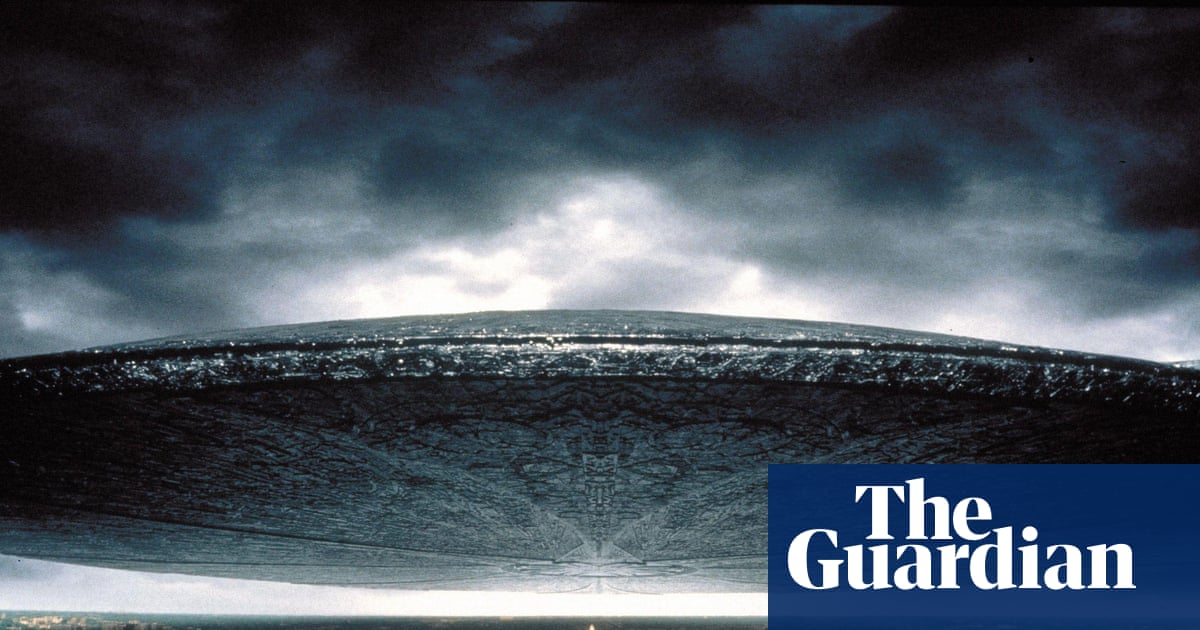
The architects of cinema’s most popular alien invasion have slightly differing accounts of how exactly the original plans for Independence Day came to them. But they both agree that it began with the now-famous image of a massive spaceship looming over a city skyline.
Roland Emmerich, the director, recalls explaining the scope of the concept to Dean Devlin, the co-writer and producer, at the latter’s home: “He lived in an area on a hill, so I said, let’s go to the window – all of what you see would be [covered by] the underside of a spaceship. He said, where’s the humor? And I said, there’s a guy knocking out an alien saying ‘welcome to Earth.’ Then we learned that Tim Burton, a director I really admire, was doing Mars Attacks! We knew that movie was coming out in August, and we said, well, there’s a great date before: Fourth of July. And that’s why the movie is called Independence Day.”
Mars Attacks! didn’t wind up making it out that summer or making anywhere near the $800m-plus worldwide that Independence Day did when it hit its titular release date in 1996, 30 years ago. Devlin also has a different account of what prompted Emmerich to think about aliens in the first place: “As I remember it, we were doing press for [their previous sci-fi hit] Stargate, and a reporter said, do you believe that aliens actually built the pyramids? We said no, and the reporter actually got angry and said, well, how can you make a movie like Stargate if you don’t really believe that the aliens built the pyramids? Then Roland said, it’s such an amazing idea: What if we woke up tomorrow morning and we walked outside to get the newspaper and above it was a 15-mile-wide spaceship blotting out the sun for an entire city? Then he turned to look at me and goes, I think I have our next movie.”
Whatever the precise origins of those 15-mile ships, Emmerich and Devlin turned the idea into a full draft in a matter of weeks, and wound up inciting a multiple-studio bidding war. So often these big-money scripts wind up disappointing at the box office, but that wasn’t the case here. Independence Day boosted the careers of just about everyone involved, especially then-rising performer Will Smith, putting him on the path to becoming the biggest star in the world. The movie itself became one of the biggest of the 90s-era summer blockbusters; at the time of its release, it became the second biggest global grosser of all time, second only to Jurassic Park.
The film also shared a star with that Spielberg smash: Jeff Goldblum, playing a satellite engineer who realizes before anyone else that the looming alien ships are planning a massive attack, and leading a sprawling story structured more like a 70s disaster movie than a typical 90s blockbuster. “We wanted to have a story of three totally different characters coming together and saving the world. We kind of modeled it after The Towering Inferno,” Emmerich says, referring to the famous 1974 disaster movie with an all-star cast that includes Paul Newman, Steve McQueen, Faye Dunaway, and Fred Astaire. The film-makers had a clear idea for Independence Day’s central trio: Goldblum, Smith, and … Kevin Spacey?!
Yes, the US president who ultimately leads the world in the fightback against the aliens, even jumping into a fighter-jet cockpit himself, was originally earmarked for a now mostly exiled actor known for the multiple accusations of sexual assault leveled against him. Originally, the president was a more slippery character: “He was a liar who finds himself in a moment of glory,” Devlin says. At the time, Spacey was known but still a novel presence, relatively untested as a star – as was the other lead the studio wasn’t so sure about. Fox execs said no to both Spacey and Will Smith. The film-makers stood their ground and eventually the studio relented: They could have one of their preferred stars, but not both. “We said OK, it’s Will Smith,” says Devlin. Emmerich describes their reaction with similar certainty: “We will find another president.”
It was a good call, and not necessarily the obvious one; it’s easy enough to picture film-makers in 1995 opting to use their clout on Spacey, especially after Seven and The Usual Suspects boosted his profile. (He would go on to win an Oscar for The Usual Suspects, albeit after Independence Day had been shot.) But Emmerich and Devlin both saw something special in Smith. “We wanted the ultimate all-American boy,” Devlin says, “and in our minds, Will Smith in real life kind of was that. He was every kid’s dream of rising to fame and fortune.” Emmerich says another contributing factor was the chemistry between Smith and Goldblum: “They’re so different from each other: Jeff, the more nebbish intellectual, and Will, totally gung-ho. It was a good combination. We also let them go free,” he adds, praising their respective skills at ad-libbing additions to their dialogue.
So Spacey was out, and the president part was rewritten for Pullman, now playing the commander-in-chief as “the sweetest guy in the world trying to deal with compromise”, Devlin says. “That fit him so much better. He’s so likable. I’m actually very grateful we ended up with Bill.” Pullman, of course, was charged with delivering what is probably Devlin’s most famous piece of writing: the president’s rousing speech to troops of the world as they prepare to counterattack the alien forces.
“I was describing this to Roland and I said, it’s very much the St Crispin’s Day speech in Henry V,” says Devlin. “Roland goes, oh great, we just have to write a speech as great as Henry V, no problem, Dean. So I said look, don’t worry about it, I’m just going to vomit something out for now, but later we’ll rewrite it, we’ll do a lot of work on it. He said, OK.” Time came to shoot the scene, and Devlin realized he never had gone back to do that heavy rewrite: “I panicked and I raced to set to rewrite this thing and they were rehearsing it. Bill knocked it out of the park and the extras went nuts. They all started screaming and jumping up and down. The only change I made was I added the line at the end: ‘Today we celebrate our Independence Day.’ I only added that because the studio wanted to change the name of the movie to Doomsday so I said, I’ve got to lock our title into the speech.”
It was just one instance of many where the 72-day shoot – unusually short for a movie of this scale, especially compared with today’s blockbusters – went easier than expected. Their faith in their chosen star was reaffirmed, Emmerich says, on the very first day of shooting. For scheduling reasons, it had to actually cover the film’s ending, shot in the California desert. Smith was the first one there, ready to go. It established a set that prioritized working together over serving anyone’s ego. “There’s a hundred speaking roles so there’s lot of room for some egomaniacs to make this difficult,” Devlin notes, “and we didn’t have any.”
The shoot also involved a great deal of visual effects – but in keeping with the movie’s throwback charm, Independence Day was very much not a showcase for groundbreaking techniques like the computer animation in Terminator 2 or Jurassic Park. Many of the film’s most renowned moments, including one that wound up as the centerpiece of the film’s Super Bowl teaser, were done practically: “The explosion of the White House was a model,” Emmerich says. “We shot a lot of stuff with painted backgrounds and photographic backgrounds. It’s the perfect mix of visual effects and models. That was our goal.” The film won an Oscar for visual effects the following year.
Emmerich also notes that the film’s teaser trailer was one of the highest-testing in studio history. The date-forward approach to the film’s concept and even title paid off: Fox got to advertise a previously unknown movie featuring its release date essentially in the title (“don’t make plans for August”, the posters suggested) – and with the memorable, American-themed (if not exactly patriotic) sight of the White House being blown to smithereens by invaders (though before the testing on the teaser came in, Emmerich says, the studio was nervous about introducing the film with that particular imagery).
Test screenings of the film itself signaled that anticipation was building. But the actual release was still unexpectedly huge. “I was in Mexico, hiding,” Emmerich says of the film’s blockbuster opening weekend. “But there was huge excitement in the air. They showed me clips of endless, endless lines … which you don’t see any more! It was a different time.” Everyone knows that the film raised Will Smith’s Hollywood profile even higher – he returned to fight more aliens in the more comic take Men in Black a year later, cementing his status as the biggest summer-movie special effect around – but Devlin notes that Goldblum was received as a rock star, too.
“I took Jeff Goldblum to the big sci-fi convention outside Denver,” he says. “He was like, why are you bringing me, nobody’s gonna know who I am? I said, Jeff to this audience, you’re bigger than Tom Cruise, and he’s, oh, get out of here! We hadn’t told the audience we were bringing him, and I go on stage, and I said, ladies and gentlemen, Jeff Goldblum, and you would have thought the Beatles walked on stage. They went insane. The look on Jeff Goldblum’s face, having no idea how loved he is by the nerd community, he was taken aback, and it was one of my favorite experiences on the movie.”
Of course, the directing-writing-producing team behind the film got a huge bump, too. After the film’s success, Emmerich notes, “everybody took me seriously. Dean and I, everyone wanted to work with us.” The pair made several more movies together, including an American version of Godzilla that was not particularly well-regarded (“I went to Japan, and hoped, actually, that they’d say no. But they said yes. For me, it was almost to prove we were [film-makers] you could count on,” Emmerich says) and the Mel Gibson hit The Patriot.
Eventually, they split to make their own films – though they did reunite for 2016’s Independence Day: Resurgence, a sequel released 20 years after the original, which neither film-maker speaks of fondly. “It was a horrible, terrible experience,” says Devlin. “I’d like to pretend it didn’t happen.” He and Emmerich were proud of their first script together in 12 years, and the studio was happy, too. But then leadership changed, the cast changed, and rewrites took the film in a less optimal direction. Emmerich concurs: “For me, it was not as satisfying, because Will wasn’t in it. Will at the very last minute dropped out to do Suicide Squad. My first idea was not to do it. But there were so many people already involved – two or three hundred people with [the production]. So we had to come up with a whole new storyline. It was all very rushed.”
The experience didn’t sour either of them on the series entirely. “I’d love to go do part three and say no, I can do this right,” says Devlin. Emmerich goes as far to say they actually have an idea for a third film – but one that would involve Smith. Big as their movie became, both Emmerich and Devlin seem to recognize that it was the human elements that got it there. As much as parts of Independence Day recall sci-fi movies like Alien and Star Wars, it’s the film’s use of a disaster-movie framework that made it feel so fresh and accessible. It also proved influential on later blockbusters like Armageddon, Transformers and Emmerich’s own The Day After Tomorrow. Even the climax to The Avengers, a superhero movie from a very different era, features anonymous alien hordes descending upon a major American city.
If Independence Day now has a reputation in some circles as a cheesier form of summer blockbuster than, say, Spielberg-level material, Devlin isn’t sweating it: “Somebody’s got to make hotdogs and popcorn and that’s what I like and what I make and I’m unapologetic about it.” (It probably helps that he fielded a congratulatory call from Spielberg when the movie came out.) As much as Spielberg is still identified with alien movies – Emmerich hasn’t yet seen the recent Disclosure Day, but plans to catch it “first thing” in his upcoming trip to Los Angeles – it’s Independence Day that made both the disaster and alien-invasion subgenres directly synonymous with summer blockbusters, not least because it’s still a holiday-rewatch staple.
In terms of the real life questions playfully posed by the recent Spielberg alien project, Devlin doesn’t think any possible otherworldly visitors would arrive here with so much hostility. “Even though I made Independence Day, I have a hard time believing that someone that has the technology to travel billions of light years to get here would do it just to pick a fight,” Devlin says. “I would imagine if you have that kind of technology, you’ve evolved to something a little bit better, or at least I’d like to think so.” In the meantime, Independence Day still makes the confrontation of those worst-case-scenario, large-scale fears fun, even comforting.






Leave a Reply